


747.309.1600
info@DigitalDynamicXray.com

18401 Burbank Blvd #107
Tarzana, CA 91356

Mon- Fri 9:00AM - 5:00PM | Sat By Appointments Only
Closed on Sundays
CRMA
CRMA: Computerized Radiographic Mensuration Analysis
Quantitative, software-based measurement of how each vertebra moves, so instability is documented in numbers rather than impressions.
Computerized Radiographic Mensuration Analysis (CRMA) is a software-based quantitative analysis of spinal radiographs. It measures intersegmental translation (mm) and angular motion (degrees) at each vertebral level, along with alignment in the neutral position, and compares the results against published, evidence-based thresholds.
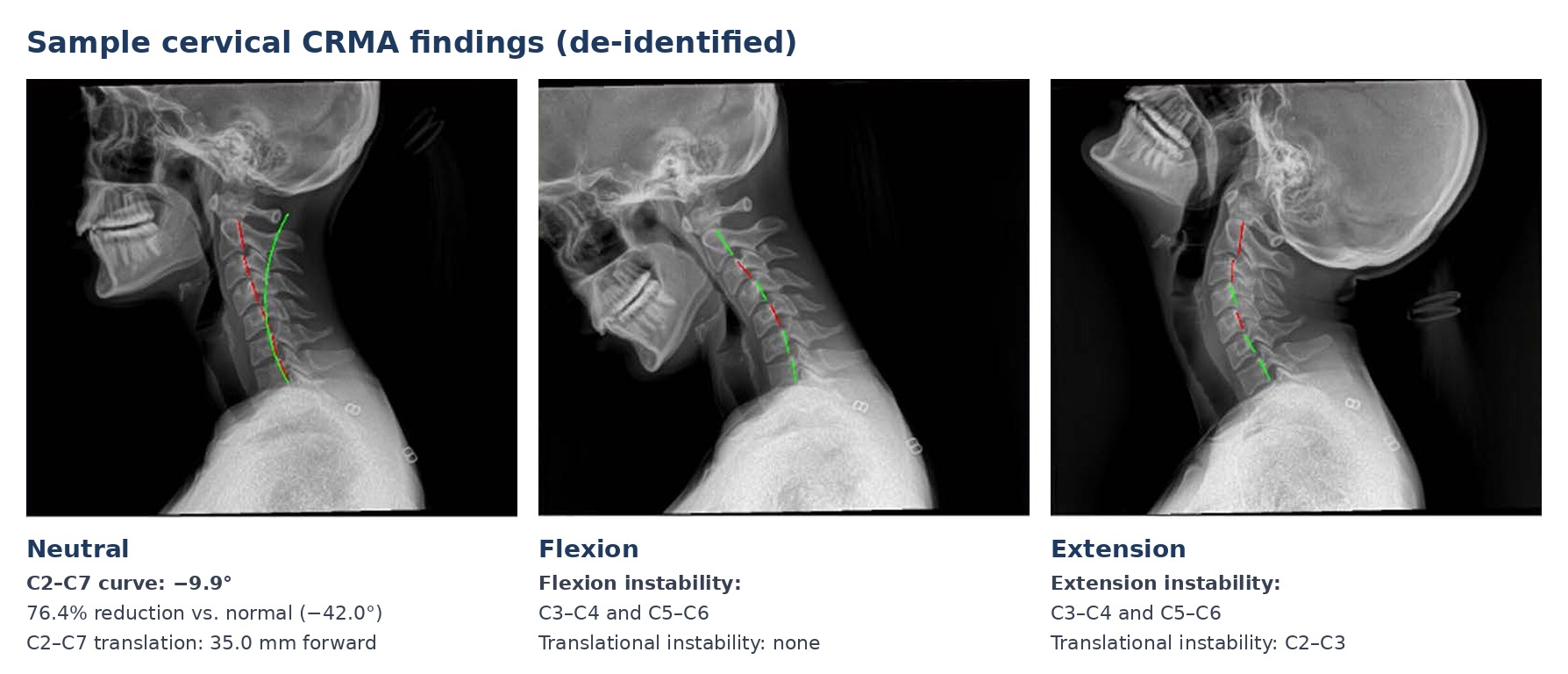
What It Shows
- Shifting: how far each vertebra slides forward or backward on the one below it, in millimeters.
- Angulation: how much each segment tilts, in degrees.
- Alignment: the curve of the spine in a neutral position.
- Aberrant motion: which specific levels exceed published thresholds.
Why Measure on DDR
CRMA measures the spine in the neutral position and at end range, in flexion and extension. Because DDR records the full movement, those end-range images come from the same study, with no additional X-rays. The rest of the motion stays available for review at every angle.
When Providers Order It
- Suspected segmental instability or craniocervical instability
- Persistent symptoms after trauma with normal static imaging
- Pre- or post-surgical motion assessment
- Personal-injury and impairment documentation
The Research Behind It
CRMA findings are compared against thresholds from the published literature and the AMA Guides, and the sources are cited in every report.
- Cervical instability thresholds. White AA, Johnson RM, Panjabi MM, Southwick WO. Biomechanical analysis of clinical stability in the cervical spine. Clin Orthop Relat Res. 1975;(109):85–96. Defines cervical instability as more than 3.5 mm of horizontal translation, or more than 11° of rotation difference from an adjacent vertebra.
- Impairment standard. American Medical Association. Guides to the Evaluation of Permanent Impairment, 5th ed. Defines alteration of motion segment integrity (AOMSI), measured on flexion and extension radiographs.
- Motion imaging accuracy. Freeman MD, Katz EA, Rosa SL, Gatterman BG, Strömmer EMF, Leith WM. Diagnostic accuracy of videofluoroscopy for symptomatic cervical spine injury following whiplash trauma. Int J Environ Res Public Health. 2020;17(5):1693. Motion imaging research co-authored by our reading radiologist.
Pricing
CRMA, Spine Only
| CRMA, first spinal region | $350 |
| CRMA, each additional spinal region (same visit) | $250 |
Available as an add-on to a DDR spine study. Delivered as a separate written report. Insurance reimbursement is not guaranteed.
To order CRMA: call 747-309-1600, fax 818-806-6213, or email info@DigitalDynamicXray.com. See all study pricing on our Pricing page.